Seamless gray resin floor after wash down with water draining across the surface
The worst time to find out about a floor is during crush.

Winery Flooring in Livermore, CA

RhynoPoxy Coatings floors Livermore Valley wineries around the one date that cannot move. A production floor has a finite life, and the difference between replacing it and being forced to patch it is whether the work was planned into a quiet window or forced on you in the middle of a harvest.

One Day Flooring
Coved and drained · Rated for crush · Booked around your window

Livermore Winery Flooring Overview

A winery floor does not fail gradually in a way you can comfortably ignore. It goes at the drains, at the tank pads and along the lines the traffic takes, and it does it under acid, water and steel wheels. Where the crush window is short, that failure lands at the worst possible moment: the weeks when the building cannot stop and nobody has a day to give up.

So the useful conversation is about timing as much as specification. What the floor is built from decides how long it lasts, and when the work happens decides what it costs you in production. Both get surveyed together. The individual systems, and what each one is built to take, are covered on our winery flooring page.

Older uncoated industrial slab in a pump room, patched and cracked around the pipework

Planned Before It Becomes Urgent

A floor replaced in a quiet month and a floor patched during harvest are two completely different jobs at two very different prices. These are the things that keep it in the first category.

Built for the load each area takes

Crush pads, cellars and barrel rooms each take their own combination of acid, water, impact and wheel load. The build is set per area to what that area actually does, so no part of the floor becomes the weak point that fails first and drags the rest forward with it.

Drains and falls that still work in ten years

Winery floors usually fail at the drain first, because that is where the water and the acid concentrate. Falls are set so they genuinely reach the drain, and the detail around the gully is built up rather than feathered in, which is what stops the edge lifting.

Coved at the wall, in one pour

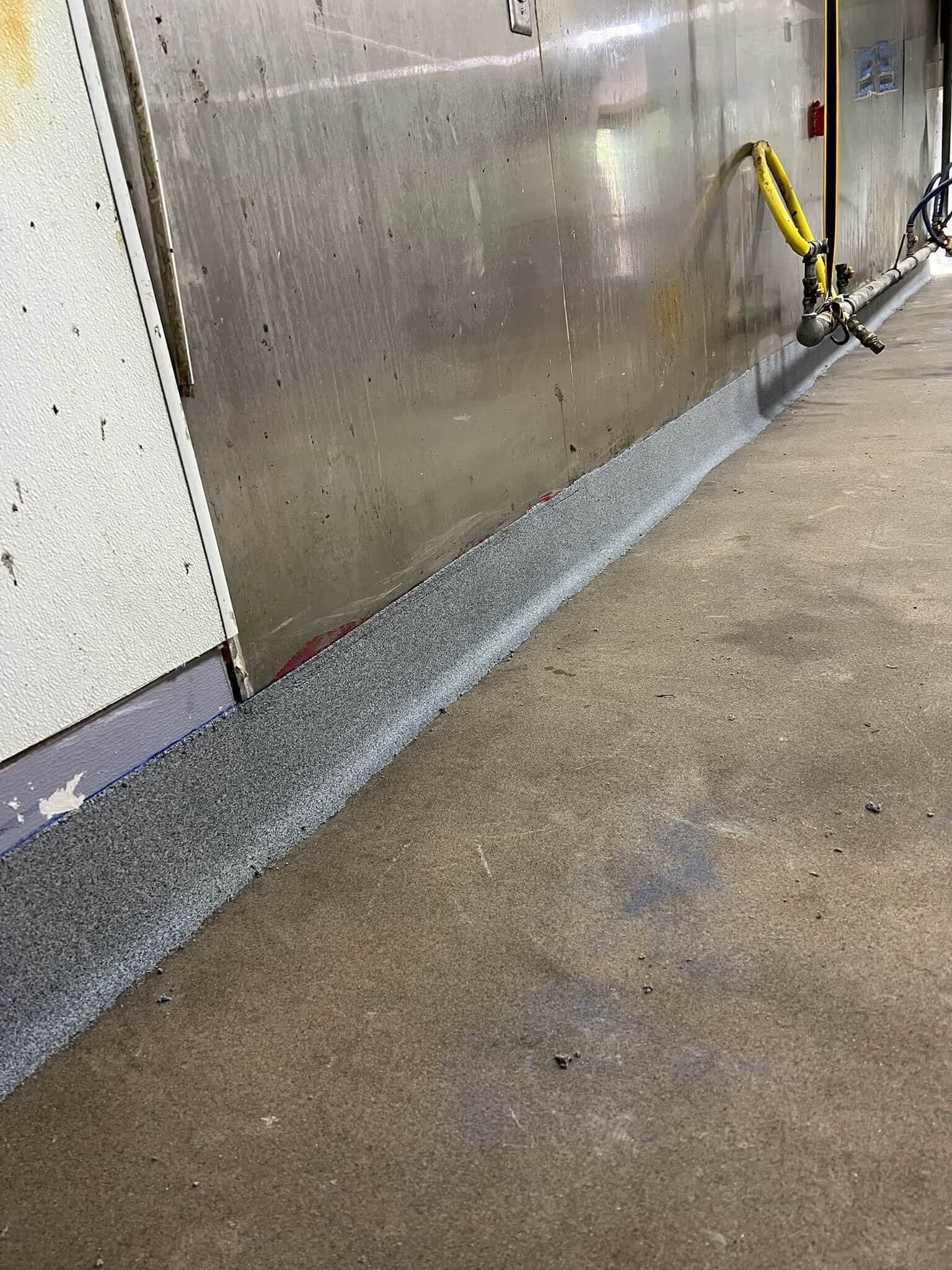
The junction between floor and wall is formed as part of the same pour rather than added afterward as a separate fillet. There is no seam at the base of the wall waiting to open up, and nothing to redo on its own in a few years.

Tank pads and equipment feet detailed

The geometry around a tank base or a machine foot is where a floor gets thin and where water finds a way underneath. Those areas are set out at survey and built properly, because they are what decides whether the floor lasts or starts lifting at the edges.

Phased so the building keeps running

Very few wineries can hand over the whole building at once. The work is split into areas that can come out of use one at a time, each one back in service before the next one starts.

A known life, not a guess

You are told what the system is rated for and what will shorten it. That is what lets the next replacement be planned into a quiet window instead of arriving as an emergency in September.

How a Livermore Winery Floor Install Runs

  • Survey against your calendar. We walk the building and go through your year at the same time: crush dates, bottling runs, the event diary, and which weeks the building genuinely has slack in it.
  • Areas ranked by condition. Not everything needs doing at once. Areas are ranked by what is closest to failing and by what would hurt most if it did, so the budget goes where it buys the most time.
  • Specification and fixed quote. You get the system, thickness, slip rating per area, the coving and drainage detail, the phasing plan and the dates each area comes out of service, priced as one number.
  • Clearing and preparation. You clear whatever is portable out of the area before its slot starts: hoses, bins, pallets, anything on wheels. Tanks and equipment bolted to the slab are left in place, and the floor is closed up to them on a cut edge. The concrete is then ground back until it is sound, and we mark out the falls before laying begins.
  • Laying and handover. The area is laid in one pass with the cove formed wet into the same material, so there is no joint where the wall meets the floor. You then get the load-up times for foot traffic, pallet jacks and full working load, along with the specification, a cleaning schedule for that system and the warranty.
Floor drain set flush into a seamless quartz broadcast floor
Background image
Commercial Kitchen Coving

Why Livermore Wineries Choose Us

  • Harvest is the fixed point, not us. Give us your crush window at survey and the dates are written into the quote. If what you want cannot be done safely in the time available, you hear that then rather than after we have started and run over.
  • Phasing is in the price. Working area by area takes longer than being handed an empty building, and that is accounted for in the quote rather than added later as a variation once you ask for it.
  • We tell you what we would leave alone. If an area has years left in it, we say so. Ranking the building honestly is worth more to you than a quote to replace all of it at once.

We also cover Livermore for garage floor coatings and industrial epoxy flooring. Elsewhere in wine country we cover winery flooring in Napa and Santa Rosa.

Frequently Asked Questions

  • Can you work during harvest?
    We would rather not, and usually we do not have to. Crush is the shortest window and the one where a delay costs the most, so the aim is always to land the work in the months either side of it. If something has already failed and genuinely cannot wait, we will tell you what can be done in the time available and what it will and will not achieve.
  • How long does a winery floor last?
    It depends on the system, the area and what runs across it. A cellar or barrel room floor lasts considerably longer than a crush pad, which takes the most acid and the most water in the shortest space of time. You are told what the specified system is rated for, so it can be planned for rather than guessed at.
  • Can you just repair the bad areas?
    Often, yes. Where the surrounding floor is sound, an area can be cut out and rebuilt to the same system so it bonds into what is already there. Where the floor has gone in several places at once, patching turns into the more expensive route, because you end up doing it again and again.
  • Do we have to empty the whole building?
    No. The work is phased so areas come out of use one at a time. You clear what can be moved from the area being worked on, and tanks and fixed equipment stay where they are with the floor finished up to them.
  • What does a winery floor cost?
    Area and build are the main drivers, then the detail: every drain, every tank pad and every phase boundary adds time. Phasing a live building costs more than being given it empty, and that difference is quoted up front rather than discovered later. You get a fixed number per area, so you can also choose to do part of it now and part of it next year.

Request a Free Quote

Interested in upgrading your concrete surfaces? Get in touch with our team today for a free, no-obligation estimate and expert advice tailored to your project.

Send us a message

Thank you! Your message has been received.

We'll get back to you as soon as possible.
Oops! Something went wrong while submitting the form.
Garage Floor Coating