
Commercial Kitchen Anti Slip Floor
Floors specified to pass inspection.

USDA and FDA Compliant Flooring in Vacaville, CA

RhynoPoxy Coatings installs seamless, non-porous flooring for Vacaville food and beverage processing plants, biotech production suites and commercial kitchens, with surfaces specified to meet USDA and FDA sanitary design requirements and to hold up under daily wash-down.

One Day Flooring
Seamless · Non-porous · Coved and drained

Vacaville USDA and FDA Compliant Flooring Overview

USDA and FDA sanitary design comes down to a small number of things an inspector can see and touch: the floor is seamless, it is non-porous, it is coved where it meets the wall, and it drains. A slab that is cracked, tiled, or coated in something that has started to lift fails on all four.

We install urethane cement and resin systems that deliver those four properties as one continuous surface, taken up the wall as integral coving and laid to falls so wash-down water reaches the drains instead of standing in the room. The compliance side of that specification is covered on our USDA and FDA compliant flooring page.

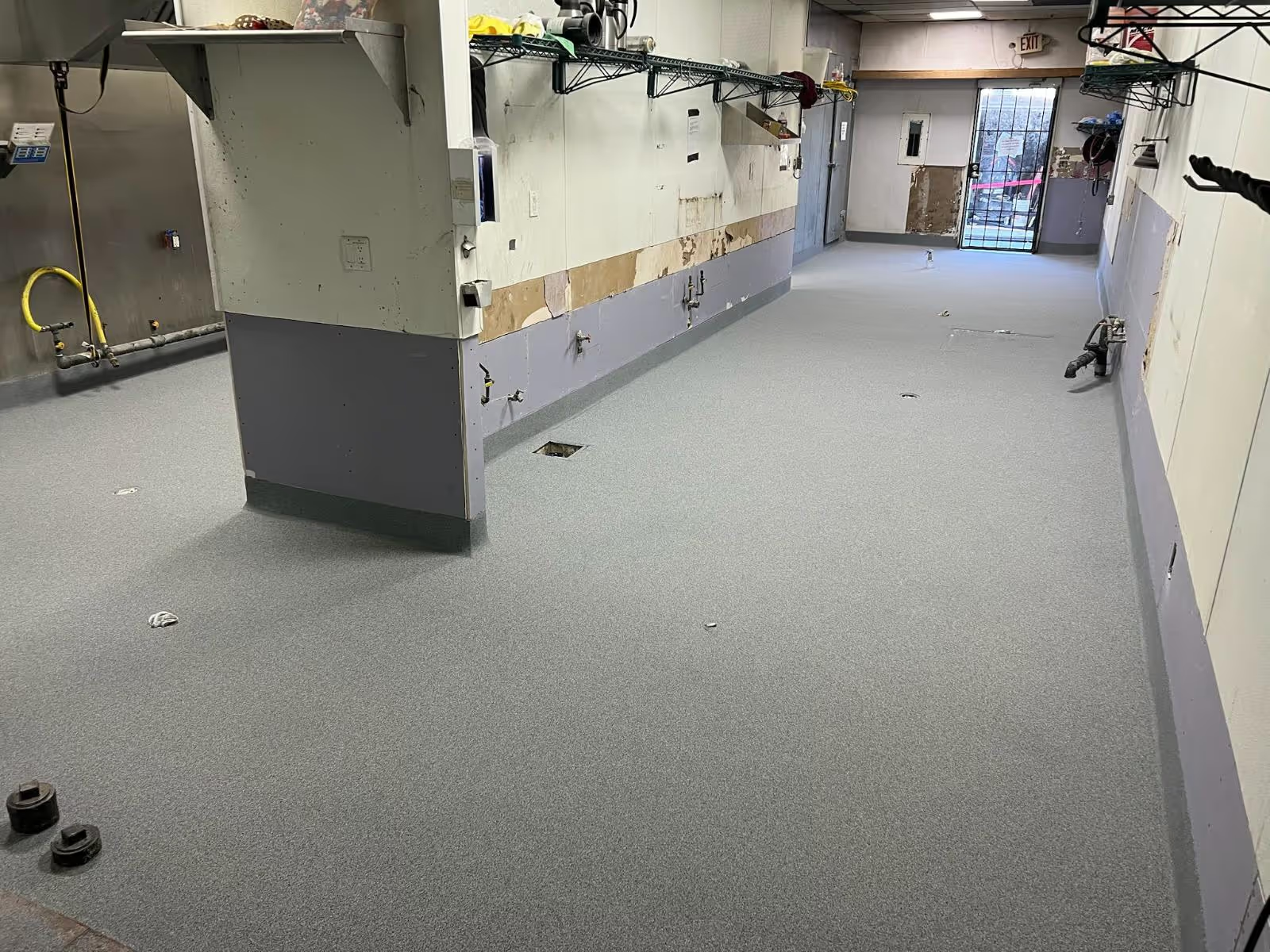
Commercial Kitchen After Epoxy Floor

What Makes a Floor Pass Inspection

Vacaville has a dense cluster of food, beverage and biologics production along the I-80 corridor, and the flooring standard in those buildings is set by what an inspector will accept. Failures are almost always at the joints, the coving and the drainage rather than in the middle of the floor.

Seamless across the whole room

No joints, no tile grout and no cold seams, so there is no line for product residue, water or bacteria to collect in and nothing there for an inspector to write up.

Non-porous surface

The finished floor does not absorb product, grease, brine or cleaning chemicals, which is what separates a genuinely easy-to-clean surface from one that stays contaminated after it has been washed.

Integral coving to the walls

Coving is formed as part of the floor pour and taken up the wall and around plinths and equipment bases, removing the floor-to-wall junction entirely rather than sealing it with a bead that eventually splits.

Laid to fall, not laid flat

Falls are set out to the drains and gullies so wash-down water clears the floor. Standing water is both a sanitary finding and a slip hazard, and it is one of the most common reasons a room fails.

Survives thermal shock

Boiling water, steam cleaning and rapid hot-to-cold cycling do not crack or debond the system, which is the failure mode that ends most epoxy floors in a wash-down room within a couple of years.

Tolerates your clean-down chemistry

Caustics, sanitizers, organic and lactic acids, sugars, fats and brine sit within the system's rated tolerance rather than slowly degrading it between inspections.

How a Compliant Floor Install Runs

  • Survey and inspection review. We walk the room with you, look at any inspection findings you are working to close out, and record the drainage layout, wash-down regime and temperatures the floor has to take.
  • Specification against the standard. You receive the system, thickness (typically 6 to 9mm where thermal shock and plant traffic are involved), coving detail, fall design and chemical tolerance in writing, so the specification can be approved before anything is ordered.
  • Preparation and drainage. The slab is shot blasted, drains and gullies are cut in or reformed, and the falls are set out before any material is laid.
  • Laying, coving and detailing. The floor is laid seamlessly with integral coving formed in the same pour, then drain terminations, thresholds and expansion joints are detailed to the same standard.
  • Handover and documentation. We confirm return-to-service times and hand over the system specification and a compatible cleaning regime, which is the paperwork you want on hand when an inspector asks what the floor is.
Epoxy Coving
Background image
Commercial Kitchen Food Grade Floor

Why Vacaville Producers Choose Us

  • We know which authority is asking. USDA-FSIS and the FDA set sanitary design expectations in processing plants, while Solano County environmental health enforces the California Retail Food Code, the health code that governs retail kitchens and prep areas. The floor specification is not the same conversation in each, and we scope it accordingly.
  • Wash-down floors are routine work here. Food, beverage and biologics production is concentrated along this stretch of I-80, and with Napa County and Sonoma County next door these systems are something we install regularly rather than occasionally.
  • Installed around production. Work is planned into shutdowns, weekends and line changeovers, because in a production room the cost of the floor is usually smaller than the cost of the downtime.

For non-food production areas in Vacaville, see industrial epoxy flooring in Vacaville. For residential work, see garage floor coatings in Vacaville.

Frequently Asked Questions

  • Will this floor pass a health department inspection?
    The finished surface is seamless, non-porous, coved to the walls and laid to drain, which is what an inspector assesses. We also hand over the system specification and cleaning regime so you can show what was installed. No contractor can promise a pass on an entire facility, but the floor will not be the finding.
  • Who actually inspects our floor: USDA, FDA or the county?
    It depends what the room is. USDA-FSIS inspects meat and poultry processing, the FDA covers most other food manufacturing, and Solano County environmental health enforces the California Retail Food Code in retail kitchens and prep areas. The sanitary design principles overlap heavily, but the authority asking the questions is different.
  • We failed on the floor at our last inspection. How fast can it be fixed?
    Preparation, drainage and laying typically run three to five days for a production room, depending on size and how much drain work is needed, and it can usually be phased so part of the operation keeps running. Give us the finding and the re-inspection date at survey and we will schedule to it.
  • Can it go into a cold store or freezer?
    Yes. Urethane cement systems cure and perform at low temperatures and are routinely installed in chillers and freezers, where a standard epoxy will either not cure properly or will fail at the first defrost cycle.
  • Can you install over our existing tiled or coated floor?
    Tiles come up. Grout lines are exactly the seam an inspector looks for, and covering them does not remove them. An existing resin coating can sometimes be shot blasted and built over where it is well bonded, and where it is not, it comes off and the room starts from bare concrete. Either way what you end up with is seamless and coved, which is what the inspection turns on.

Request a Free Quote

Interested in upgrading your concrete surfaces? Get in touch with our team today for a free, no-obligation estimate and expert advice tailored to your project.

Send us a message

Thank you! Your message has been received.

We'll get back to you as soon as possible.
Oops! Something went wrong while submitting the form.
Garage Floor Coating